
Botanical Supplement Testing Services
Herbal identification, authentication, potency, and contaminant testing for botanical supplements.
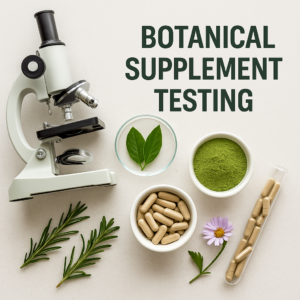
Botanical supplement testing authenticates herbal species using TLC, HPLC fingerprinting, and DNA barcoding, while quantifying active botanical markers and screening for contaminants including heavy metals, pesticides, and pathogens in herbal raw materials and finished products.
Botanical supplements present unique testing challenges: identifying complex plant matrices, authenticating species, and screening for contamination from heavy metals, pesticides, and pathogens. Qalitex Laboratories has deep expertise in botanical testing, using TLC, HPLC, and DNA-based methods to verify your herbal products.
Botanical Identification & Authentication
We use thin-layer chromatography (TLC), HPLC fingerprinting, and DNA barcoding to authenticate botanical species and detect substitution or adulteration. Essential for brands claiming specific herbal species on labels (e.g., Panax ginseng vs. Siberian ginseng).
Contaminant Testing for Botanicals
Herbs and botanicals are particularly prone to heavy metal accumulation (from soil) and pesticide residues (from agricultural use). We provide comprehensive contaminant testing panels tailored for botanical raw materials and finished herbal products.
Potency Testing
We quantify active botanical markers (e.g., curcuminoids in turmeric, ginsenosides in ginseng, hypericin in St. John's Wort, flavonoids in elderberry) using validated HPLC methods, supporting label claim accuracy and efficacy.
检测项目与方法
- ✓ Botanical species authentication
- ✓ DNA barcoding
- ✓ Active marker quantification by HPLC
- ✓ Heavy metals panel
- ✓ Pesticide residue screening
- ✓ Microbial limits testing
法规标准与合规性
- USP <563> Identification of Botanical Medicines
- AOAC 2007.01 (pesticides)
- American Herbal Pharmacopoeia (AHP)
- FDA cGMP 21 CFR Part 111
服务行业
- Herbal supplement brands
- Ayurvedic & traditional medicine products
- Tea & botanical beverage brands
- Organic herbal brands
- Contract herbal manufacturers
申请报价
价格因产品而异。告诉我们您的需求,我们将在 24 小时内通过邮件发送详细报价。
申请报价 →常见问题
How does Qalitex authenticate botanical species?
Qalitex uses thin-layer chromatography (TLC), HPLC fingerprinting, and DNA barcoding to authenticate botanical species and detect substitution or adulteration. This is essential for brands claiming specific herbal species on their product labels.
Why do botanical supplements need special testing?
Botanical supplements present unique testing challenges because complex plant matrices require specialized identification methods, and herbs are particularly prone to contamination from heavy metals in soil and pesticide residues from agricultural practices.
What botanical markers does Qalitex quantify?
Qalitex quantifies active botanical markers including curcuminoids in turmeric, ginsenosides in ginseng, hypericin in St. John's Wort, flavonoids in elderberry, and other species-specific markers using validated HPLC methods.
专项检测页面
Botanical Testing for FDA compliance
botanical supplement testing for FDA compliance
Botanical Testing for Amazon listing approval
botanical supplement testing for Amazon listing approval
Botanical Testing for Regulatory submission
botanical supplement testing for regulatory submission
Botanical Testing Near Irvine & San Diego, CA — ISO 17025 Accredited Lab
botanical supplement testing near me
Botanical Testing for Product launch
botanical supplement testing for product launch
Botanical Testing for Quality control
botanical supplement testing for quality control
为什么品牌选择 Qalitex 进行 botanical supplement testing
48 小时交付
签名 CoA 在 48–72 小时内
直接对接科学家
与负责您检测的化学家直接沟通
无最低订量
1 个或 100 个 SKU — 同等品质
相关文章
Ethylene Oxide in Spices and Botanical Supplements: The Sterilization Contaminant US Brands Still Aren't Testing For
EtO contamination triggered over 1,000 EU RASFF recalls. US supplement brands sourcing botanical ingredients face the same risk — and most aren't testing for it.
Food SafetyFunctional Beverage Compliance Testing: What Energy Drinks, Nootropic Waters, and Adaptogen Shots Must Prove Before They Ship
Energy drinks, nootropic waters, and adaptogen shots face overlapping FDA food and supplement rules. Here's what compliance testing actually requires.
Dietary SupplementsAshwagandha Withanolide Testing: What '5% Standardized' Actually Means and How Labs Detect Adulteration
Most ashwagandha labels claim '5% withanolides' — but that number hides major variation. Learn how labs use HPLC and DNA barcoding to verify label claims.
Dietary SupplementsSaffron Supplement Testing: Why Safranal Claims Are Harder to Verify Than Brands Think
Saffron is among the world's most adulterated botanicals. Learn what supplement brands must test for, which methods actually work, and why supplier COAs routinely miss the mark.
免责声明:Qalitex Laboratories 提供的检测结果是用于质量控制目的的分析数据,不构成法律、监管或合规建议。客户自行负责确保其产品符合所有适用的联邦、州和地方法规。